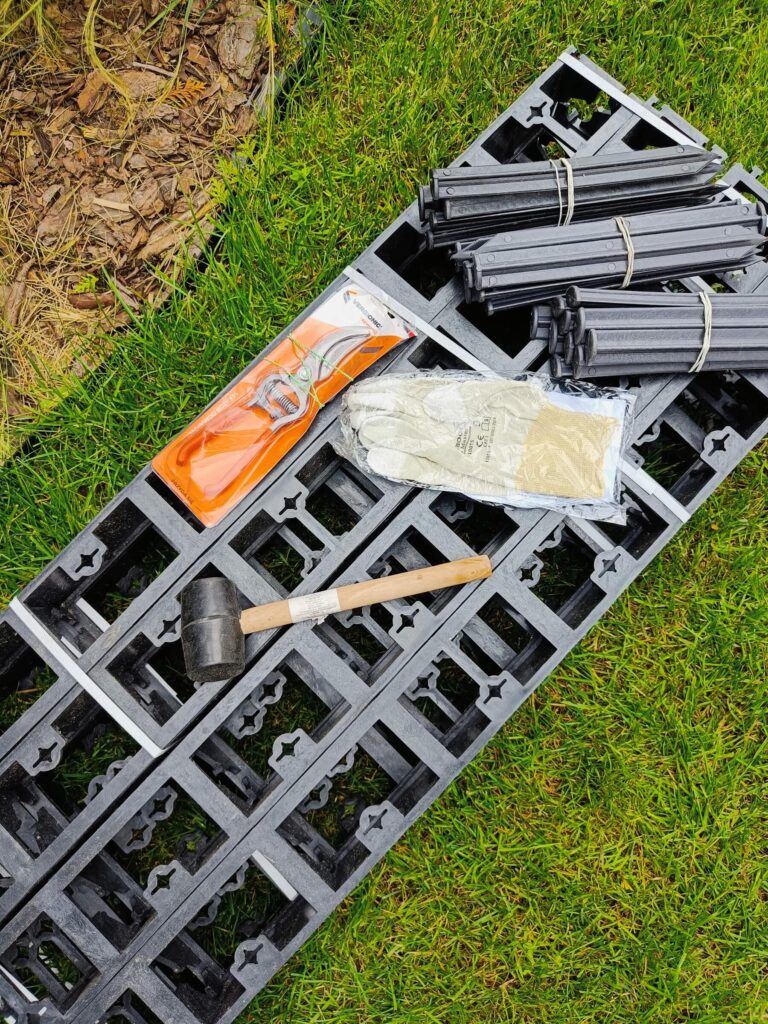
Stable lawn boundaries, flowerbeds, or gravel paths require properly securing the edging to the ground. The choice of mounting hardware depends directly on the type and hardness of the soil, the surface’s load, and the specific profile being installed. Long plastic spikes work best for soft soil, while steel nails and reinforced profiles are essential for rocky or clay soil. Read this guide to learn how to prevent edging from shifting in winter and choose accessories tailored to your garden!
The stability of garden edges depends on what you attach them with. plastic edges in a given area. Standard plastic strips have factory-made holes for mounting hardware. The main purpose of the mounting hardware is to prevent the curb from bending under the pressure of the mower and to prevent it from slipping out due to frost movement in the soil.
Depending on the substrate, three main groups of products are used:
When choosing products for installation at Sammler, it’s important to consider the anchorage depth. The sandier the soil, the longer the elements should be to ensure the edge remains stable.
The primary function of garden anchors is to transfer horizontal and vertical forces to deeper layers of the soil. When forming arches, circles around trees, or straight lines, the anchors maintain the desired shape of the plastic tape until the bark, gravel, or grass backfill is compacted.
A properly installed anchor acts as an expansion anchor. Its protrusions and serrations absorb the impact of pedestrians or light gardening equipment. Additionally, these elements protect the geotextile and agrotextile from being blown away by the wind, preventing weeds from growing along the boundary zones.
When deciding on a purchase, it’s important to consider which edge pins will be appropriate for your specific plot. Typical lengths range from 16 cm to 25 cm.
The durability of the plastic fasteners comes from the use of recycled polypropylene enriched with UV stabilizers. This prevents the material from becoming brittle in low temperatures and sunlight. Galvanized or untreated steel pins are suitable for applications where the material might bend when hammered.
Which edge anchors will perform without breaking when the property is overflowing with roots, rocks, or construction debris? In such conditions, traditional plastic elements can deform when driven in.
Steel nails or metal anchors with a round or cross profile are a solution for difficult terrain. Driving the steel pins is easy, and the element cuts through small obstacles in the ground. If you plan to work on difficult ground, Sammler offers a wide selection of durable fasteners that facilitate precise curb alignment.
When choosing specialized pins for garden edging, it’s worth understanding the characteristics of profiled fasteners. In the case of solutions such as G‑PIN and W‑PIN, the difference comes down to cross-section and application.
Design differences determine effectiveness in a given type of soil, so it is worth determining the degree of soil compaction before purchasing.
The correct selection of mounting accessories guarantees even lawn edges and a tidy garden area for many seasons. Choosing proven materials resistant to harsh weather conditions saves you time on post-winter repairs and maintenance. Check out the full range at Sammler – choose professional garden anchors and matching anchors for a stable finish for your flowerbeds.
PLAN YOUR VEGETABLE GARDEN FROM SCRATCH
REDUCE WEEDS AND TIDY UP YOUR FIELDS

Products 100%
recycled

Help in reducing
weeds

More convenient
planning the beds


 EN
EN  PL
PL  DE
DE  RO
RO  RU
RU  UK
UK