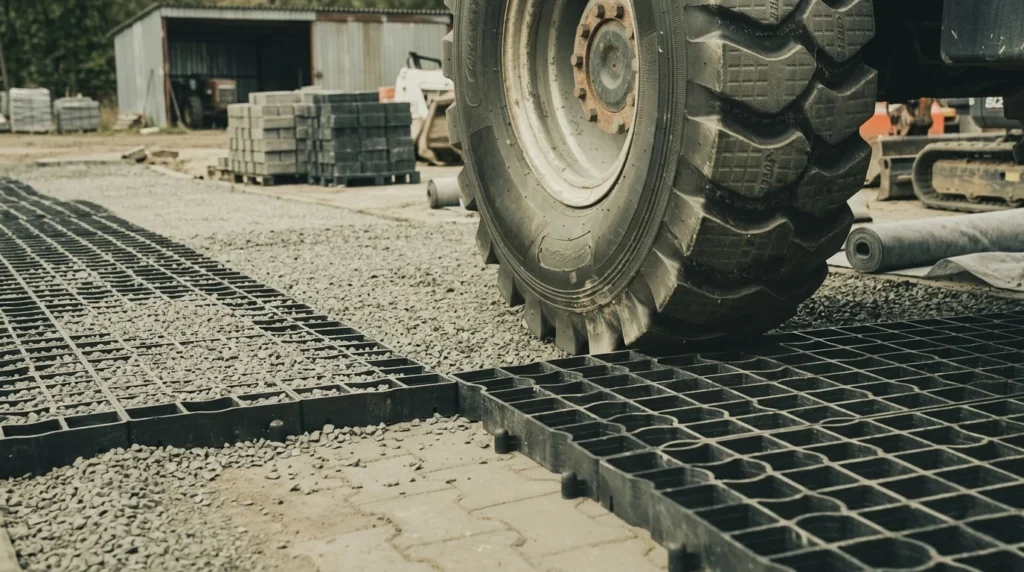
Contemporary landscape engineering and home architecture are undergoing a true revolution, with water retention and environmental concerns taking center stage. Traditional concrete screeds and paving stones are increasingly giving way to openwork solutions that allow the soil to breathe. Choosing the right system, however, is only the beginning – the key to success is thorough purchase planning and understanding the installation process to ensure the surface lasts as long as possible. In this article, we’ll discuss various aspects of this investment – from model selection, through precise calculations, to the final installation of the grids and cost analysis. We invite you to read on!
Before you begin the calculations, you need to decide which system is right for your area. Sammler offers two models in the RecRoad line: the S4 and the S5. They differ primarily in the height of their walls, which directly translates to their intended use. RecRoad S4 with a height of 4 cm is an optimal solution for home areas such as garden paths, terraces or driveways for passenger cars with moderate traffic. In turn, the version RecRoad S5, one centimeter higher than its predecessor, is a product for special purposes. This variant was designed for fire roads, truck maneuvering areas, and heavily used public parking lots. By choosing the S5, you gain a structure with higher structural rigidity, which, when filled with aggregate, can withstand loads of up to 400 tons per square meter!
Both models are made in 100% from recycled materials (PP/PE), which makes them extremely durable, frost- and UV-resistant.
Precise purchasing planning helps avoid downtime and unnecessary transportation costs. The system’s modular logic is quite simple, but it requires consideration of several technical nuances, such as cutting allowances and fill volume.
Here are the parameters that will help you with the calculation:
It, how much does it cost to lay an eco grid, depends primarily on whether you do the work yourself or hire a team. By choosing Sammler systems, you gain a huge economic advantage right from the start. The cost of the more expensive option, the RecRoad S5 grid, is currently less than 20 PLN per unit! Add to that the accessories: edges (approx. PLN 7.50 per meter), pins or anchors (starting from a few dozen groszy per unit), as well as geotextile and aggregate. The estimated cost of materials for 1 m² of a solid driveway is around 123–130 PLN. However, the real savings come in the form of labor. Traditional concrete openwork slabs are extremely heavy (up to 30 kg per unit), requiring the rental of professional equipment and hiring a crew. The Sammler S5 grid weighs just 2.5 kg. Thanks to this low weight and the extremely simple installation instructions, you can easily do it yourself. This saves you between 80 and 150 PLN per square meter, which would normally be paid to a contractor. For example, if you’re building a 50 m² driveway yourself, self-installation with the Sammler system can save you up to several thousand zlotys!
Before purchasing eco grilles it’s worth finding out, how to arrange It should be properly installed to prevent it from collapsing after the first winter. Success lies not only in the product itself, which serves as surface reinforcement, but also in what lies beneath it. The entire system must rest on a solid substructure. The process begins with trenching, which involves removing topsoil. A depth of 10–20 cm is sufficient for pedestrian traffic, but for vehicle driveways, it’s worth going down to 30–40 cm. At the bottom of the trench, we lay down a geotextile fabric, which will separate the native soil from the structural layers, preventing them from mixing – this is the most effective way to avoid rutting.
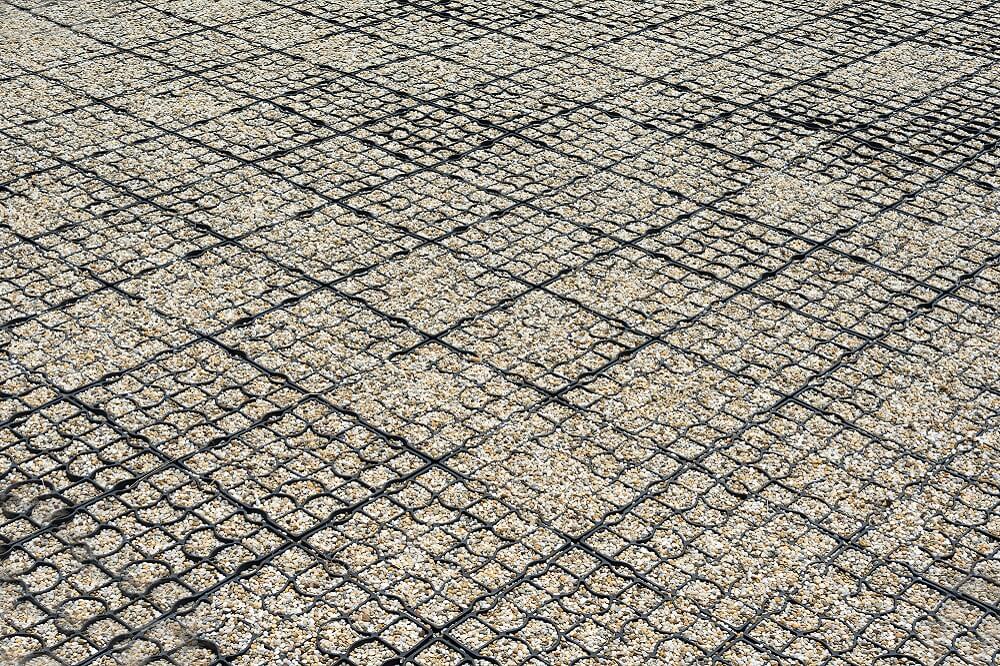
The next step is a base layer of crushed or keystone (0–31 mm fraction). It’s crucial to use crushed aggregate with sharp edges, which, under mechanical compaction, “wedges” into place, creating a rigid slab. A 3–5 cm leveling layer (sub-base) of sand or fine grit is poured onto the compacted base. Only then should the eco-grid modules be placed, connecting them with an intuitive hook system. Finally, we install the flexible RecBord outskirts and fill the holes with the chosen material. If you plan to plant a lawn, remember to finish the substrate approximately 1 cm below the edge of the trellis walls – this will protect the grass roots from being crushed by tires.
Choosing Sammler products is not just about price, but above all, durability. RecRoad grids are made of durable plastic that retains its shape for many years. Sammler eco-grid surfaces have a biologically active surface area of 871 TP3T. In an era of rising stormwater disposal fees and restrictive zoning plans, this choice allows for maximum utilization of the building plot while meeting water retention requirements.
Sammler systems are also significantly more “plastic” than concrete. The PP/PE material works with the ground during freeze-thaw cycles. Where a concrete slab might crack under pressure or frost, the eco-grid demonstrates flexibility, maintaining structural integrity. With proper installation and a suitable substructure, this surface can last for several seasons without losing its mechanical properties or shape.
When planning an investment in permeable pavement, it’s worth investing in proven solutions. Sammler offers not only modules but also a complete system of accessories – from flexible RecBord edging to mounting pins.
This comprehensive approach ensures that all components will fit together perfectly, and installation will be smooth and hassle-free. An eco-friendly grille is a choice that will be appreciated by both your wallet and the surrounding nature.
If you’re planning to pave your driveway, garden path, or parking lot, eco-grid systems from Polish manufacturer Sammler are a solution that combines exceptional mechanical durability with an environmentally friendly approach. We invite you to learn more. offer!
Yes, provided you choose the RecRoad S5 model and build a suitable subgrade (approximately 40–50 cm of crushed aggregate). Once filled, the system’s strength is up to 400 t/m², making it suitable for heavy fire brigade vehicles and garbage trucks, among others.
Absolutely not. Laying directly on the ground, especially clay, without a sub-base will result in the grids being pressed into the mud after rain, leaving the surface uneven. An aggregate sub-base is essential for load-bearing capacity and drainage.
This surface is virtually maintenance-free. If the infill is gravel, it’s enough to fill in any loose stones that may have been carried away by tires every few years. In the case of a lawn, mowing and fertilizing are standard. Importantly, the agrotextile placed under the grid effectively limits weed growth from underneath.
Yes – the Sammler system is very easy and flexible to work with. A standard angle grinder or hand saw is best for cutting the modules. This allows for perfect alignment of the grates with curbs, manhole covers, or tree trunks.
No. Unlike solid concrete slabs or asphalt, eco-grids don’t create pools of water that could freeze. Water quickly soaks into the ground, and the grid walls provide additional traction for tires and shoes.


 EN
EN  PL
PL  DE
DE  RO
RO  RU
RU  UK
UK